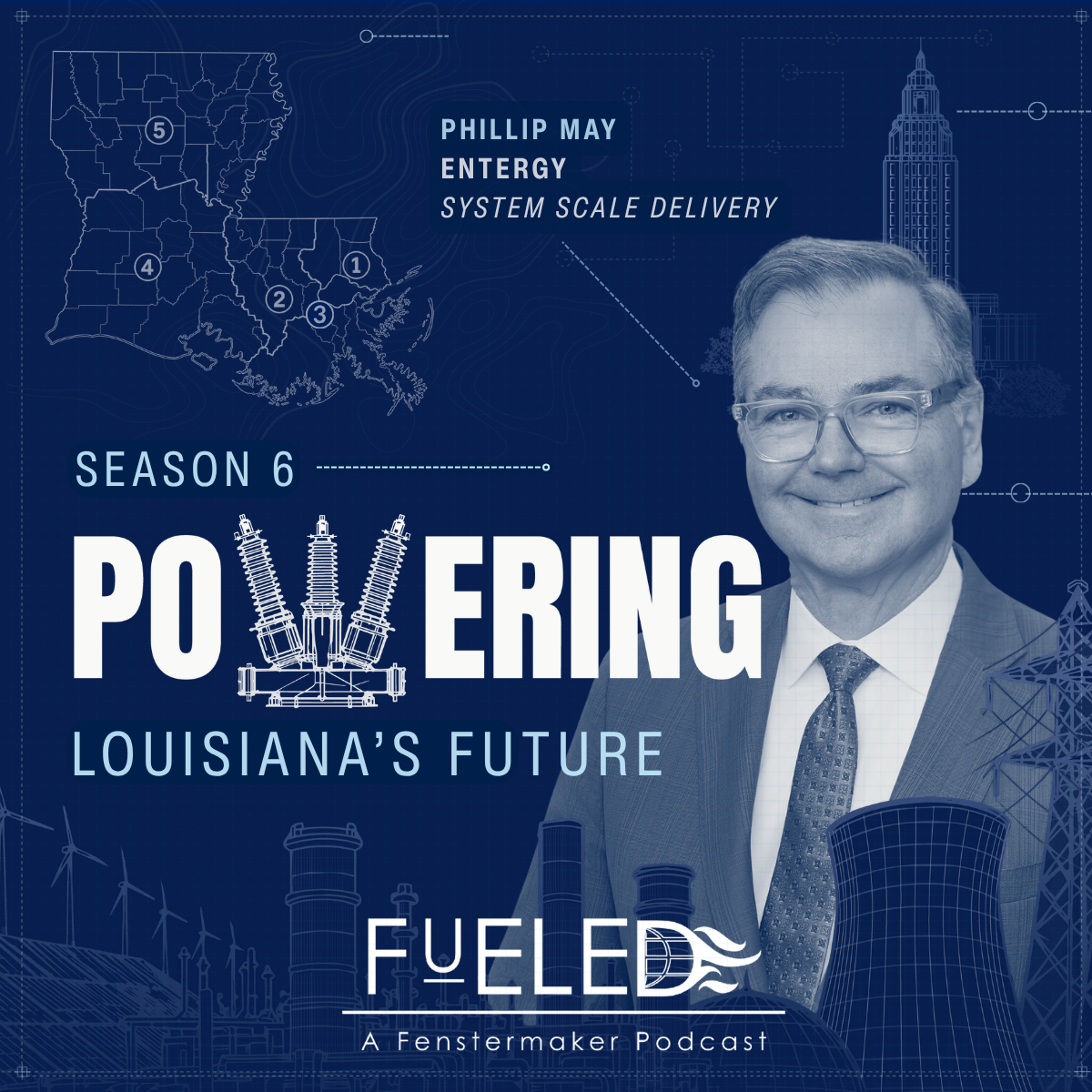

In Episode 7 of FUELED Season 6, Kathryn Fenstermaker sits down with Phillip May, President and CEO of Entergy Louisiana, for a conversation about what happens when economic ambition reaches the electric grid—and the utility responsible for making it work.
The episode serves as the system-scale capstone to a season spent examining Louisiana’s power landscape from multiple perspectives. May has worked inside that system for nearly four decades, joining Entergy in 1986 and leading Entergy Louisiana since 2013. His career now spans two very different eras: one defined by relatively modest electricity growth and another emerging as industrial expansion, artificial intelligence, advanced manufacturing, and extraordinarily large loads reshape what the grid is being asked to do.
May explains that this shift is no longer simply about adding incremental capacity. Projects such as Meta and Hyundai Steel require Entergy to reconsider the system at a much larger scale—generation, transmission, substations, distribution, fuel supply, redundancy, and resilience together. The opportunity is not only to serve new customers but to use that growth to build a stronger system for the customers already here.
That opportunity comes with a nonnegotiable principle: growth must pay for growth.
May repeatedly returns to affordability throughout the conversation. New demand, he argues, cannot simply be layered onto the existing customer base. Infrastructure created specifically for large-load customers must be assigned to those customers, while the broader system should receive measurable benefits from their arrival.
That framework leads into Entergy’s Fair Share Plus approach. May explains that large-load customers pay for the infrastructure directly attributable to their service while also contributing toward existing system costs that otherwise would be borne by current customers. Long-term contracts, minimum bills, customer collateral, accelerated depreciation, and exit obligations are designed to protect existing customers if a project develops differently than anticipated.
May says Entergy’s current Louisiana data-center agreements are expected to create more than $2.8 billion in direct benefits for other customers over the next two decades. He also points to commitments involving Power to Care assistance, home-energy-efficiency investments, workforce development, and infrastructure improvements. His answer to those skeptical of the promised benefits is straightforward: “We’ll put our money where our mouth is.”
The conversation also examines one of the defining phrases of Louisiana’s current economic-development moment: speed to power. May describes a “power-first world” in which major companies want to know not only whether electricity will be available, but how quickly it can be delivered. Entergy began preparing before the current wave fully arrived, securing turbines and other long-lead equipment as proposed projects grew from tens of megawatts into hundreds and, eventually, gigawatts.
Moving quickly, however, does not eliminate the need to measure risk. Entergy evaluates whether a company has acquired land, possesses the financial and technical capacity to execute, operates within a market capable of supporting the investment, and is willing to make meaningful contractual commitments. This becomes especially important with data centers, whose construction schedules can move much faster than traditional generation projects.
The discussion then widens from individual projects to the power system Louisiana is becoming—a grid that must be larger, more redundant, more resilient, and capable of moving extraordinary amounts of electricity without sacrificing affordability or reliability.
Energy supply must also diversify. Entergy is building highly efficient natural-gas generation, expanding solar and battery storage, exploring additional nuclear opportunities, and considering how emerging technologies could fit its portfolio over time. Each resource has a role to earn based on customer needs, reliability, cost, timing, performance, and risk.
Generation, however, is only half the equation. Louisiana must simultaneously build the transmission system capable of moving power where it is needed. In May’s telling, generation and transmission are not separate strategies; they are pieces of the same effort to create a bigger, stronger, more redundant grid.
Resilience brings that strategy down to everyday life. May says the objective is not to promise that extreme weather will never interrupt electricity. It is to build a system that recovers much faster when it does. He points to Grand Isle remaining energized through Hurricane Francine as tangible evidence that previous hardening investments can change system performance.
As the conversation approaches its close, the question becomes what Louisiana cannot afford to get wrong. May’s answer is simple: wait. Major industrial and technology companies operate on compressed timelines, and Louisiana’s ability to deliver will help determine whether the current wave of investment compounds into something larger or moves elsewhere. Success requires moving at the speed of customers while preserving the discipline that keeps investments reliable and affordable.
For May, however, the ultimate measure is not megawatts, plants, or even projects announced. It is whether Louisiana becomes a place where people can build their futures. He shares the story of a young engineer who heard about Meta’s investment and decided it might finally be time to move home. A decade from now, May wants stories like that to be commonplace: communities thriving, opportunity expanding, and Louisianans no longer forced to choose between the place they love and the careers they want.
That vision also answers the closing question. What fuels Phillip May is the opportunity to transform the state he loves in a way Louisiana has not seen in generations—and to create a future where his own daughters, and families across Louisiana, can come home and thrive.
At its heart, this season finale is about execution at scale: moving fast without abandoning discipline, building ahead without building recklessly, asking growth to carry its own costs, using extraordinary new demand to strengthen the system already here, and ensuring Louisiana’s historic economic opportunity ultimately reaches the people who call it home.