Menu
Episode 4 – Powering Louisiana’s Future

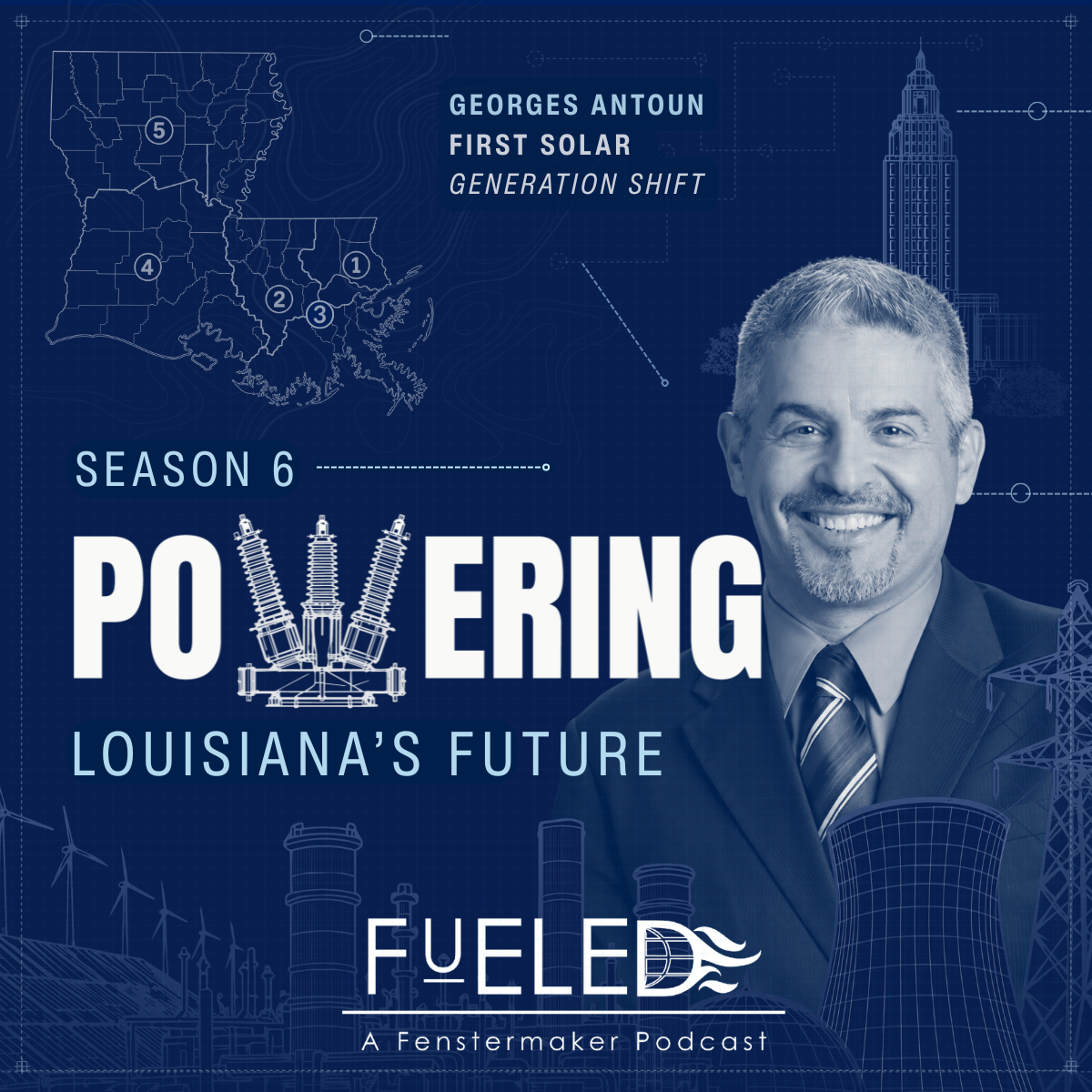
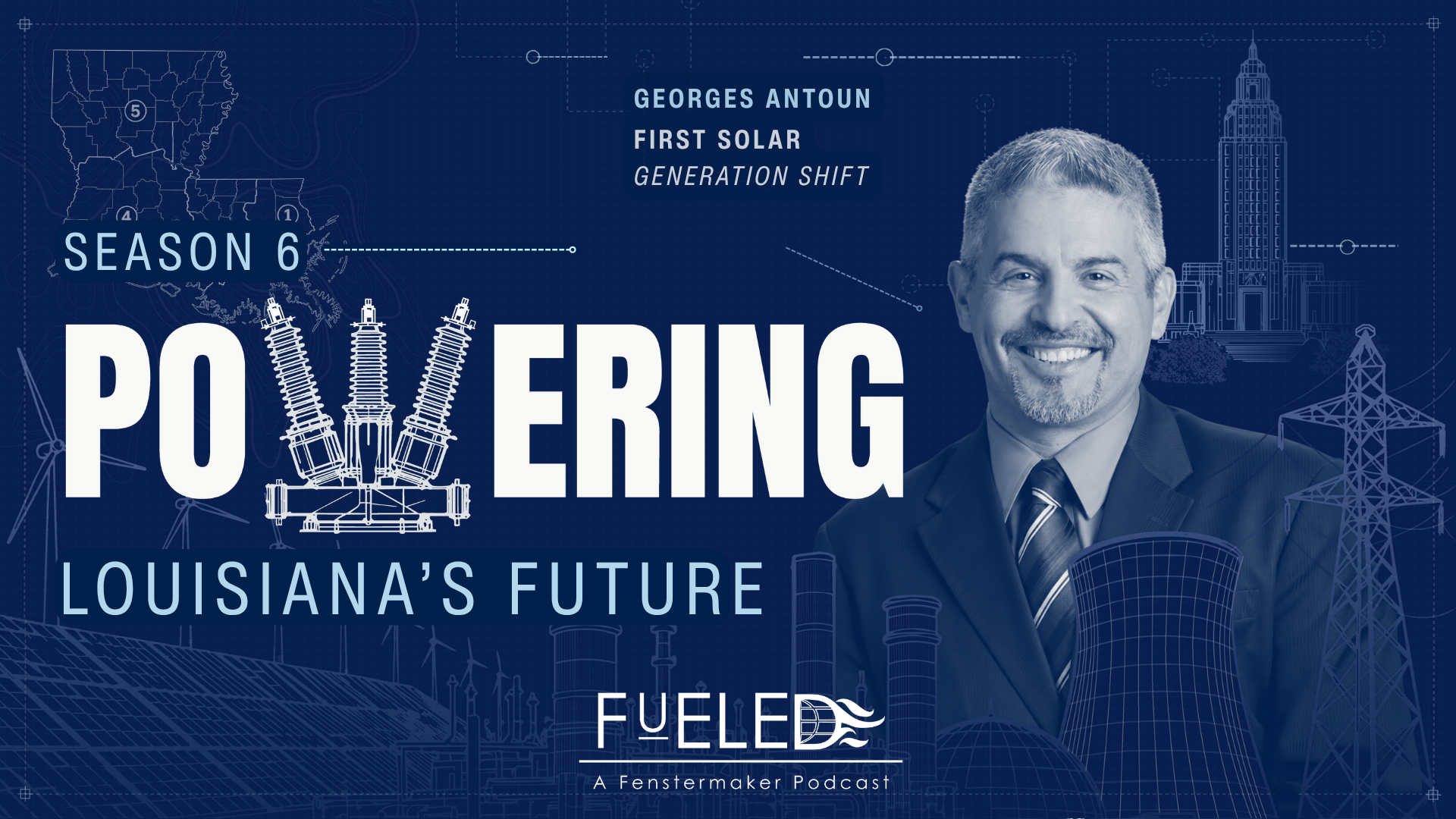
Generation Shift: Georges Antoun on First Solar and the Future of American Power

First Solar Chief Commercial Officer Georges Antoun joins FUELED to discuss utility-scale solar, advanced manufacturing, AI, reliability, domestic supply chains, and Louisiana’s energy future.

Share on:

Episode Summary

In Episode 4 of FUELED Season 6, Kathryn Fenstermaker sits down with Georges Antoun, Chief Commercial Officer of First Solar, for a conversation about utility-scale solar, American manufacturing, and the generation shift shaping Louisiana’s energy future.

The episode moves the season from power delivery, public power strategy, and grid resilience into the question of generation itself. Antoun explains First Solar’s role in the power ecosystem as a solar panel manufacturer whose technology turns photons into electrons and becomes the engine of large-scale solar generating assets.

Antoun clarifies the difference between rooftop and utility-scale solar, emphasizing scale, cost, grid integration, and the importance of allowing electric-system experts to plan and manage generation assets. He also addresses one of the most persistent misconceptions about solar: the difference between reliability and intermittency. Solar, he explains, can be a reliable part of a diversified generation portfolio, especially when paired with storage, transmission planning, and modern grid operations.

The conversation also brings First Solar’s Iberia Parish facility into focus. Antoun explains why Louisiana made sense for the company’s $1.1 billion, AI-enabled manufacturing investment, pointing to workforce availability, transferable oil and gas skills, educational partnerships, and the region’s readiness to sustain advanced manufacturing at scale. For Antoun, the facility is not only a solar story; it is an American manufacturing story and a Louisiana workforce story.

Throughout the episode, Antoun describes how First Solar turns research and development into durable thin-film modules and how artificial intelligence, sensors, cameras, and automation are changing production. The New Iberia facility can turn a sheet of glass into a solar module in roughly four hours and produce thousands of modules each day, connecting local labor and domestic supply chains to national energy demand.

The discussion widens to the forces driving solar deployment, including data centers, AI, industrial growth, electrification, and the need for speed to power. Antoun identifies interconnection, supply chain, and permitting as major constraints, while explaining why domestic manufacturing and supply-chain certainty are increasingly important to customers.

At its heart, this episode is about what it takes to make new generation real: the people, planning, technology, manufacturing, supply chains, and infrastructure required to move solar from a concept people debate to a resource that can help power communities and industries. Antoun closes with a broader view of Louisiana’s opportunity—staying open-minded, embracing diversification, and recognizing that energy is ultimately a team sport built around people, jobs, and long-term competitiveness.

"We are not selling electricity. We are selling reliability."

"You could put a sheet of glass at the beginning of the factory, and four hours later you have a module."

Meet the Leader Behind the Vision

Georges Antoun serves as Chief Commercial Officer of First Solar, one of the world’s leading solar technology and manufacturing companies. Raised and educated in Lafayette, Louisiana, Antoun began with an engineering foundation before building a career across telecommunications, network systems, technology, manufacturing, and energy.


At First Solar, Antoun brings a systems-level perspective to one of the defining infrastructure questions of our time: how the United States builds enough reliable, affordable generation and manufacturing capacity to meet rising demand. His work sits at the intersection of commercial strategy, customer certainty, domestic supply chains, technology deployment, and large-scale execution.


Antoun’s perspective is especially meaningful for Louisiana. He describes First Solar’s Iberia Parish facility as a story of labor, transferable skills, advanced manufacturing, and local opportunity. For him, the state’s energy future depends not on choosing one resource over another, but on remaining open-minded, building what is needed, and creating sustainable jobs that allow future generations to stay and thrive.

"American-made, American quality is important."

"The fastest way to generate power is solar."

Generation Shift: Georges Antoun on First Solar, Utility-Scale Solar, and Louisiana's Energy Future

In this episode of FUELED, Georges Antoun explains how utility-scale solar becomes part of the power ecosystem, from manufacturing and technology to grid integration and customer demand. The conversation explores the difference between rooftop and utility-scale solar, the role of scale in lowering cost, and why solar belongs in the broader generation mix alongside natural gas, nuclear, storage, and transmission planning. Antoun also takes listeners inside First Solar’s domestic manufacturing strategy, including the company’s $1.1 billion AI-enabled facility in Iberia Parish. From advanced automation and real-world energy yield to American-made supply chains and recycling, this conversation reveals how Louisiana is participating in the next chapter of American power.

"Supply chain is critical."

"When you think of the American manufacturing story, we are the example."

Episode Highlights

  • Understanding First Solar’s role in the power ecosystem, including how its thin-film solar modules convert sunlight into electricity and become the central generating component of utility-scale solar projects.
  • How utility-scale solar differs from rooftop solar, from project size and cost efficiencies to system management, grid connection, and the role of electric utilities.
  • Why First Solar chose Iberia Parish, and how Louisiana’s skilled workforce, transferable oil and gas experience, infrastructure, and economic-development support helped attract the company’s $1.1 billion manufacturing investment.
  • Building Louisiana’s advanced manufacturing workforce, through collaboration with UL Lafayette, SLCC, LED, and a regional talent base prepared for engineering, technical, operational, and support roles.
  • Moving solar technology from research to manufacturing, including the years of development, durability testing, quality control, and engineering required before a module can be produced at scale.
  • Designing modules for long-term performance, and how CuRe technology, temperature performance, durability, and reduced degradation help improve energy yield in hot and humid environments.
  • Manufacturing solar modules at scale, as sheets of glass move through a continuous four-hour production process capable of producing approximately 17,000 modules each day at the Iberia Parish facility.
  • Using AI and automation to improve manufacturing, through robotics, cameras, sensors, and real-time decision-making that strengthen quality, productivity, and throughput while changing the skills employees bring to the factory floor.
  • Strengthening America’s domestic solar supply chain, through coordinated U.S. manufacturing facilities, American-made materials, shared production standards, and greater certainty for customers and energy infrastructure.
  • Responding to rapidly growing power demand, as data centers, artificial intelligence, industrial development, electric vehicles, and broader electrification create an urgent need for new generation.
  • Solar’s role in a diversified generation portfolio, including the distinction between reliability and intermittency and how solar, battery storage, natural gas, nuclear, and other resources can work together to support the grid.
  • Planning for speed, reliability, and certainty, as utilities and major energy users evaluate cost, supplier dependability, construction schedules, and the ability to bring new generating assets online when they are needed.
  • Overcoming the barriers to new solar development, including limited interconnection capacity, supply-chain constraints, permitting requirements, land considerations, and the long process of securing access to the grid.
  • Understanding behind-the-meter generation, and why some data centers and other large energy users may consider building dedicated power resources rather than waiting for traditional grid interconnection.
  • Advancing responsible solar across the full life cycle, from material selection and manufacturing emissions to module durability, recycling, and end-of-life planning.
  • Preparing Louisiana for its next energy chapter, through economic diversification, skilled labor, advanced manufacturing, open-minded energy planning, and a willingness to support multiple forms of generation.
  • Leadership, purpose, and giving back, as Georges reflects on the opportunities America provided him and his desire to leave a stronger future for the next generation.

"Innovation is the catalyst for growth."

"Energy is a team sport."

More from FUELED

Conversations across seasons—on infrastructure, leadership, and public impact.

Established in 1950, C. H. Fenstermaker & Associates, L.L.C. is a highly diversified, multi-disciplinary consulting firm. With a commitment to help our clients succeed, we specialize in surveying and mapping, engineering and environmental consulting.

Click here for complete information about the licensing boards governing our Survey and Engineering professionals.

©2026 C. H. Fenstermaker & Associates, L.L.C.. All Rights Reserved.
Privacy PolicyTerms.